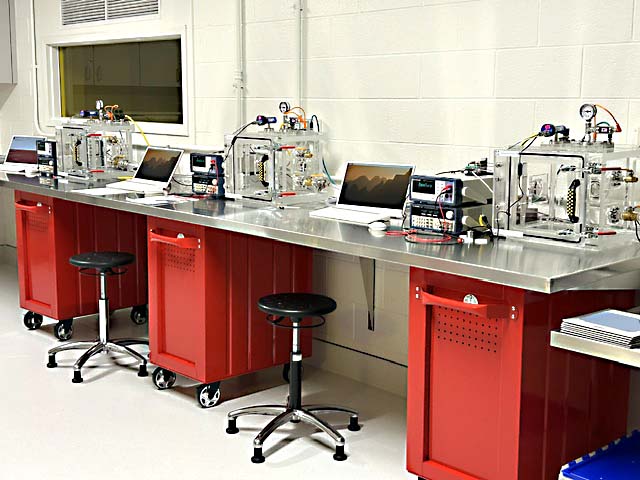
A new Washtenaw Community College clean room environment set to open this fall, along with training through a National Science Foundation project, will help prepare students for careers in Michigan’s growing microelectronics sector, including semiconductor-related fields.
To support WCC’s related certificate and associate degree programs launched last year, the new clean room will provide a training ground for students to gain hands-on experience with the tools, protocols and precision required in real-world manufacturing settings to advance the state’s workforce.
Additionally, WCC has received an NSF sub-awardee grant through a Michigan State University project.
The college’s $200,000 funding through the NSF grant provides “AI for Advanced Semiconductor Manufacturing” workshops for WCC students, faculty and adult learners at MSU and Fraunhofer USA’s state-of-the-art facility in East Lansing, connecting them directly to cutting-edge research and careers in semiconductor technology and exploring the growing role of artificial intelligence in advanced manufacturing.
The first cohort participated this past summer, gaining hands-on experience with wafer fabrication, machine learning, data cleaning, and analysis. Participants also earned an official Fraunhofer USA certificate, validating their working knowledge of industrial AI deployment and semiconductor quality control.
Through the MSU and Fraunhofer partnership, WCC participants can experience semiconductor manufacturing and emerging technologies firsthand while building skills relevant to Industry 4.0 careers. The broader NSF-funded project also explores advanced semiconductor technology using lab-grown diamond, an emerging material with the potential to improve performance in electronics and energy systems.
The core part of the grant at MSU includes teams using artificial intelligence to grow high-quality diamond in labs, an emerging material with the potential to significantly improve performance in electronics and energy systems, and which could be the key to the future of semiconductor manufacturing and advancing workforce talent in the U.S.
The microelectronics workforce, which includes semiconductors, is projected to grow in the U.S. as technology needs increase, including the use of silicon microprocessors utilized in vehicles and appliances.
Manufacturers integrate chips and advanced electronics in modern vehicles, medical devices, clean energy systems and more. A modern vehicle, for example, can contain 1,000 to 3,000 semiconductors, powering everything from battery management systems to safety features and advanced driver assistance technologies.
According to the U.S. Bureau of Labor Statistics, the median annual wage for semiconductor processing technicians in 2024 was more than $51,000, with the highest earning more than $87,000.
Momentum in WCC’s education and training for emerging careers in the microelectronics space has been growing for several years.
In 2023, the state's Michigan Semiconductor Talent and Technology for Automotive Research (MSTAR) initiative was launched, with WCC announced as an education partner. Other MSTAR partners are the Michigan Economic Development Corporation (MEDC), KLA Corporation, University of Michigan, Belgium-technology innovation hub imec and General Motors.
WCC’s Advanced Manufacturing Clean Room, its Soldering Lab and equipment, training opportunities, education outreach with K-12 students and teachers, and related associate and certificate programs have followed.
Semiconductor Manufacturing (ELE 206) is the first class offered in the new clean room in the Fall 2026 semester. The two-credit course introduces students to the manufacturing processes behind high-tech semiconductor devices.
Students gain hands-on experience in a clean room environment while learning about vacuum systems, occupational safety, sensors, SCADA and statistical process controls.
Additional semiconductor-related programs launched last year with support from the MEDC are:
• Associate of Applied Science in Engineering Technology, with concentrations in Semiconductor & Battery Manufacturing and Industrial Electronics, as well as four embedded certificates.
• Advanced Certificate in Semiconductor & Battery Manufacturing, to equip students with the specialized skills required for careers in advanced manufacturing, focusing on semiconductor fabrication and battery technology.